Insert into a Binary Search Tree
You are given the root node of a binary search tree (BST) and a value to insert into the tree. Return the root node of the BST after the insertion. It is guaranteed that the new value does not exist in the original BST.
Notice that there may exist multiple valid ways for the insertion, as long as the tree remains a BST after insertion. You can return any of them.
Example 1:
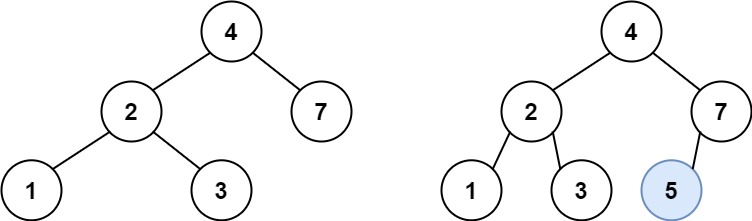
Input: root = [4,2,7,1,3], val = 5
Output: [4,2,7,1,3,5]
Explanation: Another accepted tree is:
Example 2:
Input: root = [40,20,60,10,30,50,70], val = 25
Output: [40,20,60,10,30,50,70,null,null,25]
Example 3:
Input: root = [4,2,7,1,3,null,null,null,null,null,null], val = 5
Output: [4,2,7,1,3,5]
Constraints:
- The number of nodes in the tree will be in the range .
- All the values are unique.
- It is guaranteed that does not exist in the original BST.
使用した概念Binary Search Tree
アプローチ
思考
- BSTが前提
- nodeとvalを比較する
- valの方が大きければ、nodeをrightに
- valの方が小さければ、nodeをleftに
- Noneになればappendして、rootを返す
実装
class Solution:
    def insert_into_bst(self, root: Optional[TreeNode], val: int) -> Optional[TreeNode]:
        if not root:
            return TreeNode(val)

        node = root

        while node:
            if node.val > val:
                if not node.left:
                    node.left = TreeNode(val)
                    break
                node = node.left
            else:
                if not node.right:
                    node.right = TreeNode(val)
                    break
                node = node.right
        return root
Time Space