Add Two Numbers
You are given two non-empty linked lists representing two non-negative integers. The digits are stored in reverse order, and each of their nodes contains a single digit. Add the two numbers and return the sum as a linked list.
You may assume the two numbers do not contain any leading zero, except the number 0 itself.
Example 1:
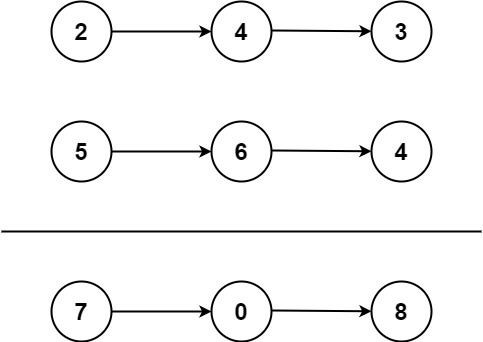
Input: l1 = [2,4,3], l2 = [5,6,4]
Output: [7,0,8]
Explanation: 342 + 465 = 807.
Example 2:
Input: l1 = [0], l2 = [0]
Output: [0]
Example 3:
Input: l1 = [9,9,9,9,9,9,9], l2 = [9,9,9,9]
Output: [8,9,9,9,0,0,0,1]
Constraints:
- The number of nodes in each linked list is in the range
[1, 100]. 0 <= Node.val <= 9- It is guaranteed that the list represents a number that does not have leading zeros.
アプローチ
思考
- 両方のNodeの値を計算した合計値のlinked listを作成する
- whileでどちらかのノードがNoneになるまで処理を続ける
- 両方のNodeの値を取り出し、計算しNodeを作成し追加
- 作ったノードを追加した。
実装
class Solution:
    def addTwoNumbers(self, l1: Optional[ListNode], l2: Optional[ListNode]) -> Optional[ListNode]:
        cur_l1, cur_l2 = l1, l2
        new_node = ListNode()
        carry = 0
        dummy = ListNode()
        dummy.next = new_node

        while cur_l1 and cur_l2:
            val_l1 = cur_l1.val
            val_l2 = cur_l2.val

            total = val_l1 + val_l2 + carry
            carry, val = divmod(total, 10)

            sum_node = ListNode(val)
            new_node.next = sum_node
            new_node = new_node.next
            cur_l1 = cur_l1.next
            cur_l2 = cur_l2.next

        if cur_l1:
            while cur_l1:
                val_l1 = cur_l1.val
                total = val_l1 + carry
                carry, val = divmod(total, 10)
                sum_node = ListNode(val)
                new_node.next = sum_node
                new_node = new_node.next
                cur_l1 = cur_l1.next

        if cur_l2:
            while cur_l2:
                val_l2 = cur_l2.val
                total = val_l2 + carry
                carry, val = divmod(total, 10)
                sum_node = ListNode(val)
                new_node.next = sum_node
                new_node = new_node.next
                cur_l2 = cur_l2.next

        if carry:
            carry_node = ListNode(carry)
            new_node.next = carry_node
            new_node = new_node.next

        return dummy.next.next
Time Space
注意点
- コードが冗長
- 値を取得、加算、持ち越しの処理が重複している。
- 値が存在しない場合のケースを対応して、単一関数内で処理をする。