Path Sum
Given the root of a binary tree and an integer targetSum, return true if the tree has a root-to-leaf path such that adding up all the values along the path equals targetSum.
A leaf is a node with no children.
Example 1:
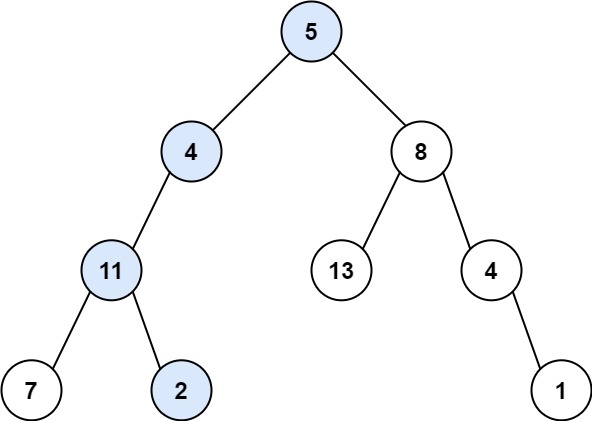
Input: root = [5,4,8,11,null,13,4,7,2,null,null,null,1], targetSum = 22
Output: true
Explanation: The root-to-leaf path with the target sum is shown.
Example 2:
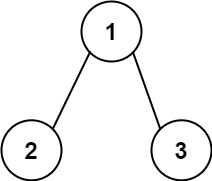
Input: root = [1,2,3], targetSum = 5
Output: false
Explanation: There are two root-to-leaf paths in the tree:
(1 --> 2): The sum is 3.
(1 --> 3): The sum is 4.
There is no root-to-leaf path with sum = 5.
Example 3:
Input: root = [], targetSum = 0
Output: false
Explanation: Since the tree is empty, there are no root-to-leaf paths.
Constraints:
- The number of nodes in the tree is in the range
[0, 5000]. -1000 <= Node.val <= 1000-1000 <= targetSum <= 1000
アプローチ
思考
- 全ての root-to-leaf パスの合計を dfs で求めて、リストに格納する
- targetSum がリストに含まれているかで判定する
実装
class Solution:
    def hasPathSum(self, root: Optional[TreeNode], targetSum: int) -> bool:
        if not root:
            return False

        sum_list = []

        def dfs(node, cur_sum):
            if not node:
                sum_list.append(cur_sum)
                return

            cur_sum += node.val
            dfs(node.left, cur_sum)
            dfs(node.right, cur_sum)

        dfs(root, 0)

        if targetSum in sum_list:
            return True
        return False
Time Space
注意点
- leaf 以外の子(None)に到達するたびに cur_sum を append してしまっている
- 1, 2 の場合、正しい path sum は 3 のはずだが、1, 2, 3 のような余分な値も対象になり誤検知になる